


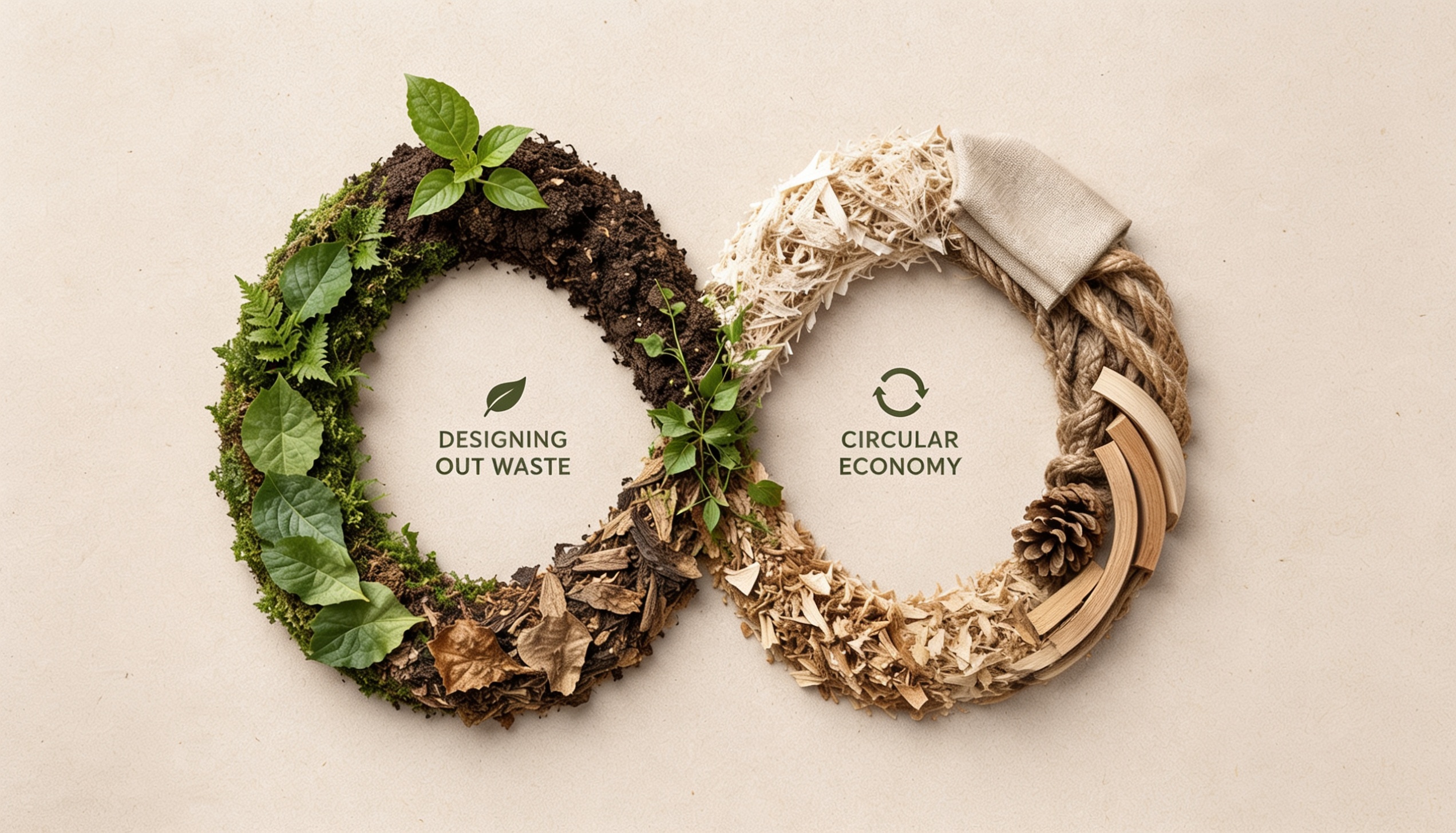

The circular economy is often presented as a hopeful correction to the failures of linear growth. Close the loop. Keep materials in use. Design out waste. It sounds elegant, optimistic, even redemptive, yet it can be too reassuring.
At its simplest, the circular economy is an approach to production and consumption that aims to keep materials circulating for as long as possible. It replaces the traditional “take-make-dispose” model with one that reuses, repairs, recycles and repurposes materials, ideally reducing pressure on natural resources and minimising waste. In theory, it is about creating value while staying within environmental limits. For infrastructure owners, municipal leaders, and asset designers, this promise is particularly attractive in the face of tightening budgets and rising environmental expectations.
In practice, however, circular economy thinking has slipped into a way to postpone uncomfortable choices about overproduction, excess, and the limits of what systems can genuinely sustain. Instead of asking whether something should exist at all, we focus on how it might be recovered later.
At Zutari, we encounter this tension regularly across municipal infrastructure, industrial facilities, and resource recovery projects. Circular ambitions are often compelling in principle, yet their success depends on realities that sit beyond design itself: funding, operations, maintenance capacity and long-term ownership. We see both the potential and the limitations of circular economy thinking when aspirations for circularity collide with practical implementation.
None of this is an argument against circular economy principles. Resource efficiency, material recovery and waste reduction remain essential in a resource-constrained world. The challenge is ensuring that circularity is treated as a design discipline rather than an aspiration. Too often, the language of circularity assumes ideal conditions while overlooking the operational realities that determine whether the systems succeed over time.
This is less a design revolution than a comfort mechanism.
Circularity today is frequently designed after the fact. Products are launched with vague promises of recyclability. Buildings rise under the banner of “future adaptability”. Infrastructure is justified through the comforting assumption that someone, somewhere, will deal with it downstream. The burden is shifted from those who initiate material flows to those who must live with their consequences.
Local authorities know this pattern well. They inherit materials never designed for separation, volumes never designed for recovery, and systems never designed for financial reality. Recycling plants grow more complex not because materials demand it, but because designers upstream refuse to confront limits.
Every highly engineered recovery facility is, in its own way, a physical record of a design failure elsewhere.
Consider a material recovery facility designed around ambitious recycling targets. On paper, the system performs exceptionally. In practice, inconsistent separation at source, fluctuating commodity markets, constrained municipal budgets, and shortages of skilled operators can quickly undermine performance. The challenge is often not the technology itself, but the assumption on which it depends.
The circular economy narrative rarely acknowledges this. It prefers neat diagrams of loops and cycles that imply control and balance in systems driven just as much by behaviour, politics and markets as by design. Leakage is not the exception; it is the rule.
Yet many circular systems are built on the assumption that failure is rare.
They depend on stable markets for recovered materials, consistent separation at source, reliable maintenance, skilled operators and steady funding. When these assumptions falter, circular systems do not fail gracefully. They can deteriorate into contamination, stockpiles, fire risk and neglect.
A circular system that cannot fail safely is not sustainable. It is fragile.
There is also a quieter ethical concern embedded in circular design: the displacement of cost. Circularity often redistributes environmental and social burdens rather than eliminating them. Labour intensity increases downstream. Health risks concentrate around recovery sites. Informal workers absorb the inefficiencies that formal systems design out of sight.
When we celebrate circular outcomes without asking who carries the burden, we mistake motion for progress.
Perhaps the most uncomfortable truth is this: sometimes the most circular decision is not to design at all. Not every material warrants a second life. Not every product justifies a recovery system. Not every loop deserves to exist. The belief that we can out-engineer excess is comforting, but it is also misguided.
Restraint is rarely seen as design excellence.
The profession tends to reward complexity, innovation and expansion. Yet in many cases, the most responsible innovation is the one that reduces material demand, simplifies systems or avoids unnecessary infrastructure altogether. In this sense, restraint may be the most radical circular act available to us.
In practice, restraint might mean smaller projects, simpler material palettes, extending the life of existing assets, or delaying investment until there is a clear, maintainable path for operation.
Designing for a circular economy should not begin with the question, “How do we close the loop?” It should begin earlier and more awkwardly: “Do we need this loop in the first place?” If the answer is yes, then design it honestly, for failure, for maintenance, for limitation, and for the people who will inherit it long after the diagrams have faded.
Circularity is not achieved at the recycling plant. It is decided, or denied, at the moment of design. Until we accept that some interventions should never exist, circular economy thinking risks becoming what it too often is today: a beautifully drawn way of avoiding responsibility.
What this means in practice
If circularity is to mean anything, it must move upstream, into the decisions that shape systems before they exist. This is where engineering, planning and advisory firms can make a practical difference, not by reinforcing circular narratives, but by grounding them in reality.
At Zutari, this means helping clients:
• Asking earlier, harder questions: Should this exist at all?
• Designing for real-world conditions, not ideal ones
• Bridging the gap between infrastructure ambition and municipal capacity
• Making trade-offs visible: financial, environmental and social
• Advocating for restraint where complexity adds more burden than value
This is not about closing every loop. It is about choosing the right ones—and being honest about their limits.
Zutari can help by:
- Interrogate need at the outset by asking whether a proposed asset, material system or recovery process is necessary, proportionate and appropriate to local realities
- Design for failure as well as performance, ensuring systems can degrade safely, be maintained realistically, and continue to function when funding, markets or operational capacity fall short
- Align design ambition with implementation capacity by matching technical solutions to the institutional, financial and operational conditions that will determine whether circular systems work in practice
- Making hidden trade-offs visible by identifying the financial, environmental and social consequences of circular interventions, including who carries risk and responsibility downstream
- Integrate engineering, planning and advisory expertise so that circular principles are grounded in delivery reality, not only policy aspiration
- Supporting adaptable, context-specific solutions that are robust, repairable and appropriate to African urban, industrial and municipal conditions rather than importing models that depend on idealised assumptions
Our role is not simply to help close the loops. It is to help clients determine which interventions are worth pursuing, which systems can realistically be sustained over time and where simplicity may create more value than complexity.
Circularity is not measured by how effectively materials move through the system. It is measured by whether the system can endure over time, financially, operationally, and socially. The most responsible design decision is not always to close the loop. Sometimes it is to simplify it, scale it back or avoid creating it altogether.
True circular thinking begins not with recovery, but with responsibility. It starts by asking the hardest questions in design: should this exist in the first place?

