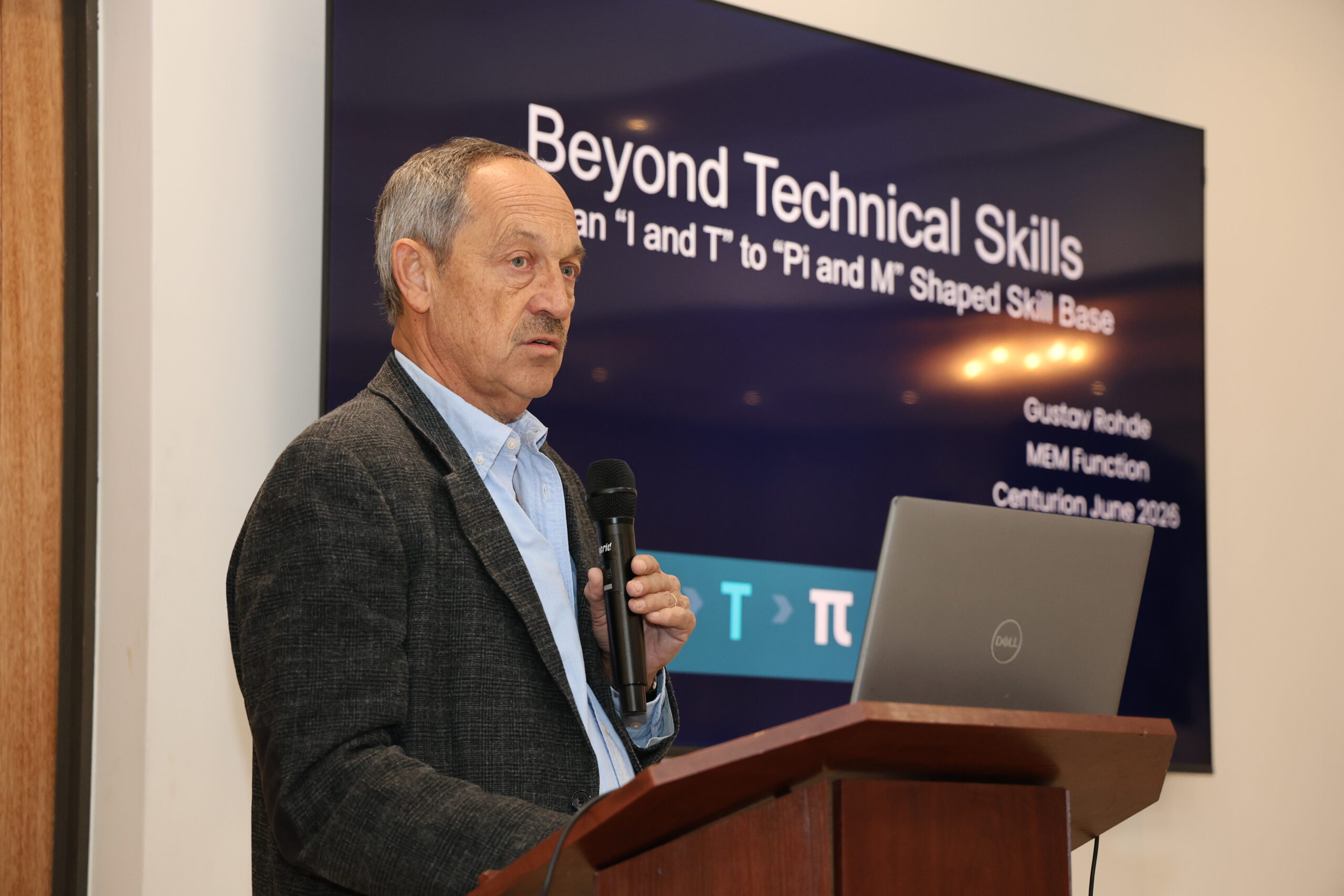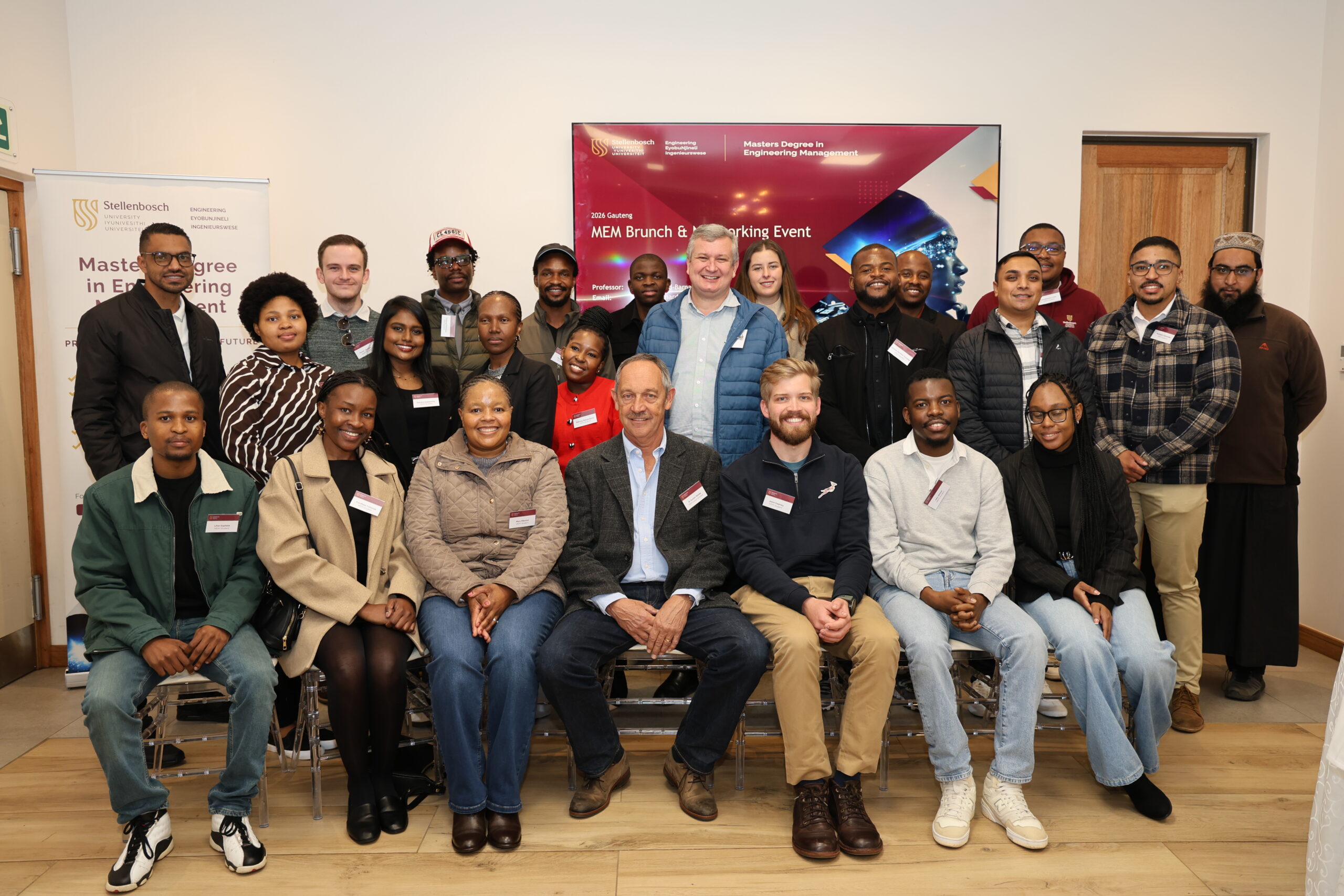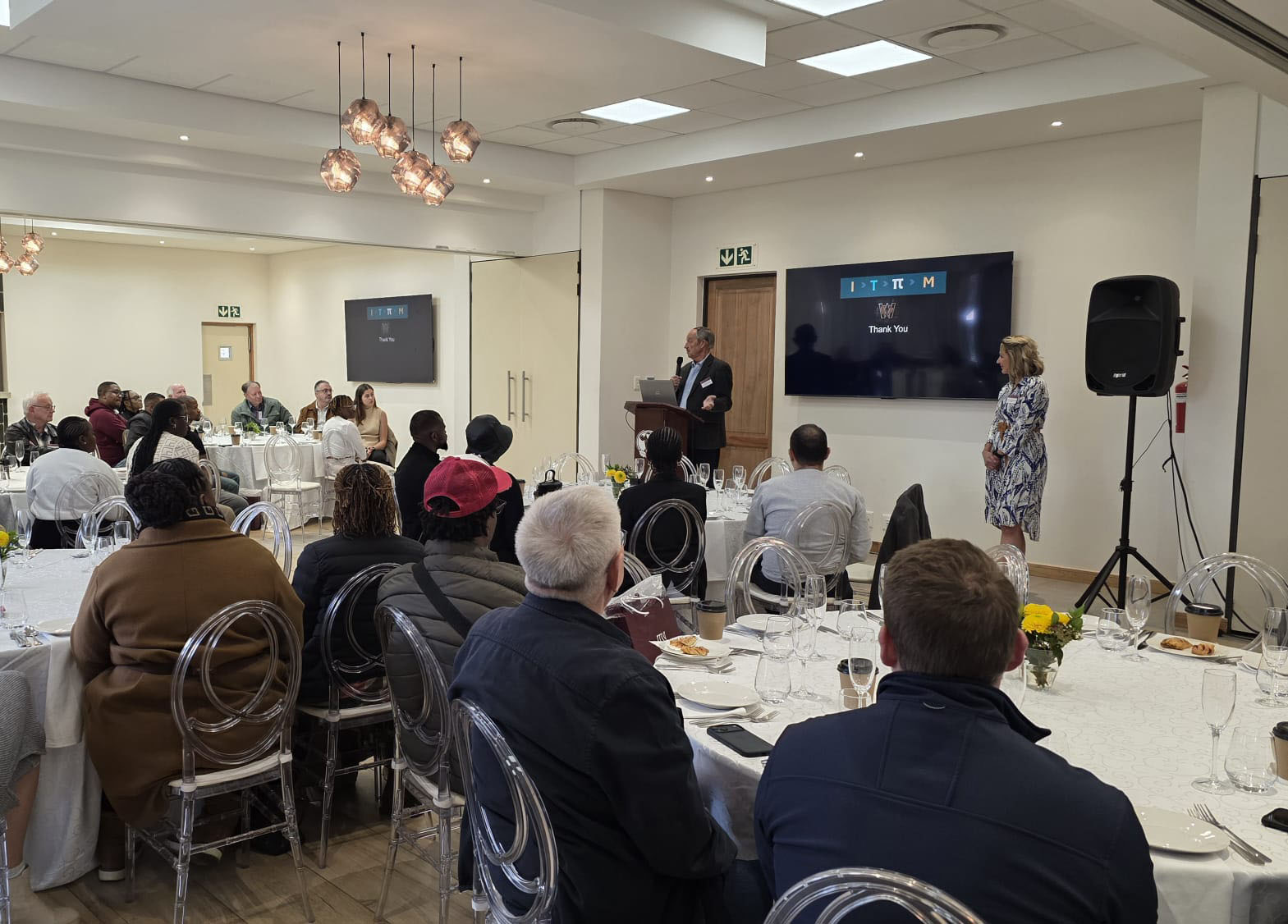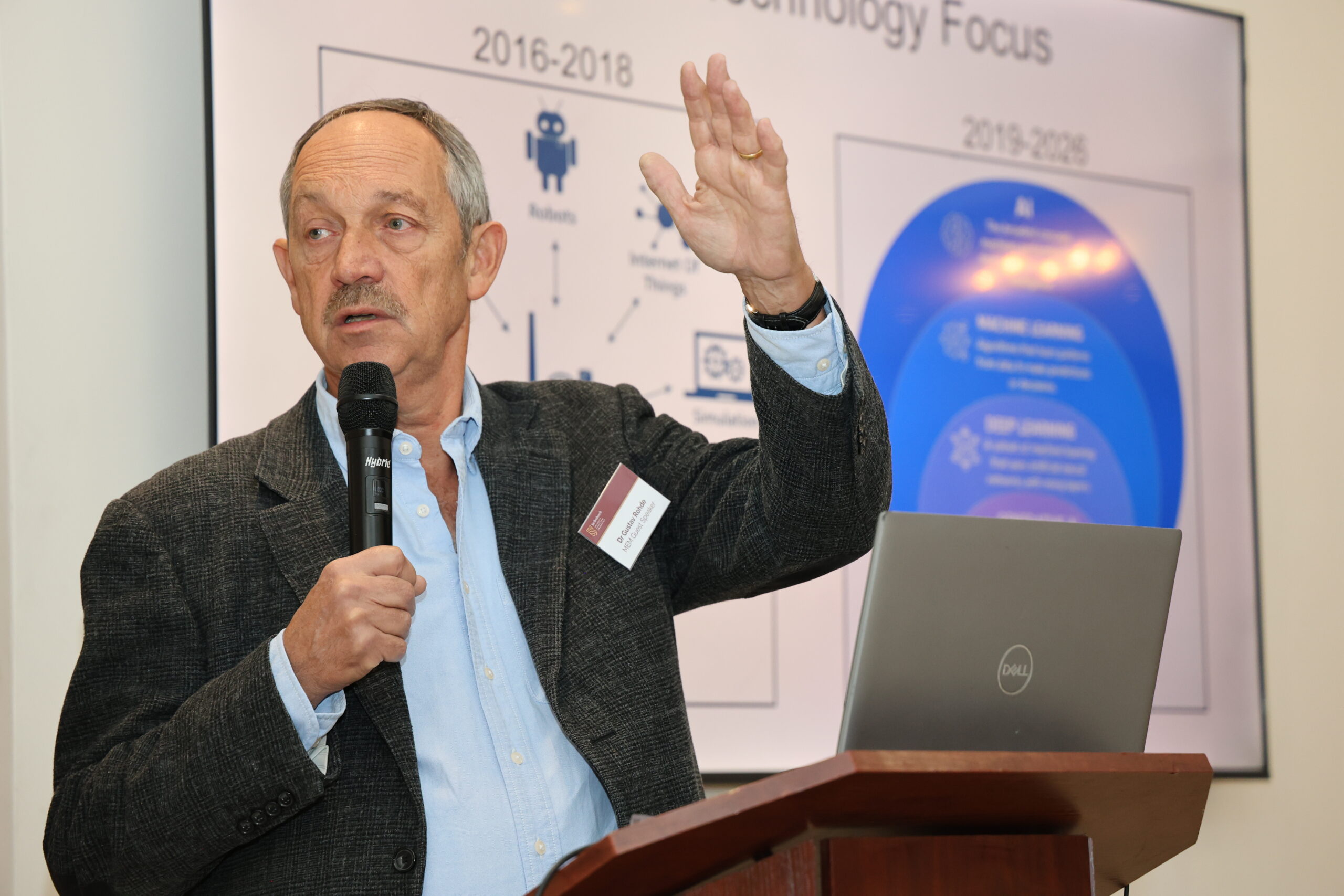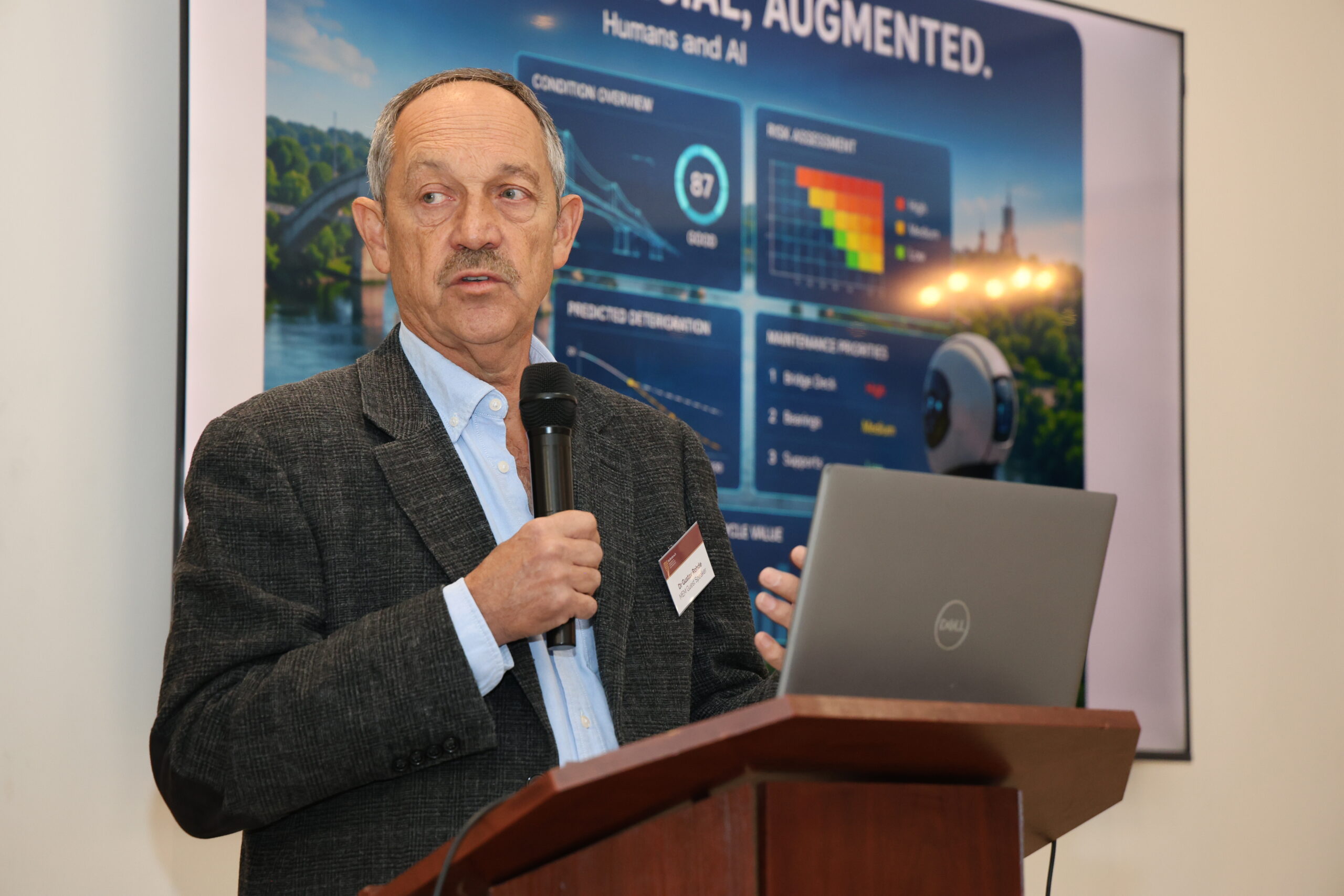

Address to Stellenbosch University’s Faculty of Engineering’s MEM Students and Alumni
Dr Gustav Rohde, 27 June 2026, Centurion, South Africa.
Historically engineers relied predominantly on their technical education and subsequent experience. A solid base of science and mathematics, enhanced by formal engineering education and then real-life experience in solving problems, guaranteed a fulfilling engineering career.
This deep knowledge and experience in a single discipline can be represented by the letter I. In the dynamic and uncertain world often referred to as VUCA (volatile, uncertain, complex, and ambiguous) engineering proficiency needs to be augmented by the development of emotional intelligence, collaboration, communication and management skills, as well as the ability to work with other disciplines. This intersection and integration of hard (technical) and soft skills have become crucial to being a successful professional. This combination of skills can be represented by the Letter T (Johnston, 1978; Chief Executive, 2010).
T shaped skills are also often seen as a balance between being a specialist and generalist. The question is often asked…should you go broad or deep? Both generalists and specialists have room to play. What is more critical is a balance between technical and soft skills. Technical skills allow you to perform the work; whilst soft skills help you influence the outcome, lead, collaborate, and adjust. Even in career advancement it has been found that technical skills often get you hired but soft lateral skills such as emotional intelligence, leadership, and collaboration are major factors in career advancement.
In the 2025 World Economic Forum “Future of Jobs” report Analytical Thinking, Resilience, Agility, Flexibility, Leadership, Influence, Creative Thinking and Self Awareness are cited as the most relevant skills for the future. These are the very skills to intercept and enhance the technical mastery and result in a T shaped professional.
The many emerging technologies flowing from the 4th industrial revolution, are causing digital disruption in engineering (Rohde 2018). Engineers are now required to blend their historic technical and lateral soft skills with digital competencies, data analytics, artificial intelligence and computational design. They are increasingly required to upskill in terms of programming and coding skills, become efficient in human-machine interfaces, practice data analytics and management, as well as being able to do computational thinking. In short this implies skills beyond the previous I and T-shaped skills. Future engineers will have to become Pi Shaped in terms of their skills. (Hortal 2014)
With the rapid advances in AI the future relevance and need for deep technical skills are questioned by some. Aren’t digital skills, strong AI tools, and some soft skills enough? A good analogy is the advent of calculators. The calculator automated calculation not what was calculated. AI does the same; it automates parts of the process, but skilled humans are still required to decide what problem to solve, verify results and make decisions. In fact, recent studies strongly indicate the Pi shaped skilled professionals can unlock more from AI than those relying on AI and not understanding the underlying technicalities (Tambe 2026).
There is a growing realization that there is a sweet spot of human intelligence and AI. This can be referred to as augmented intelligence. It treats AI as a force multiplier for engineering judgement, not a replacement for it. Humans should be involved in the process to ensure accuracy, safety, accountability, and ethical decision making. A deep technical understanding can guide an AI application and avoid computer hallucinations. Ideal interaction occurs when:
- AI focuses on breadth, humans on depth
- AI brings speed, humans sense
- AI become the perfect thought partner
- AI is guided by humans in continuous dialogue to tune for context, intent, and values
In recent work by Hemmer et al (2025) the researchers found that the real value of AI is not automation, but complementarity. That is situations where humans and AI possess different strengths, information, or capabilities that can be combined to achieve results neither could achieve independently. It requires augmented intelligence and depends on humans with Pi shaped skills. Engineers with technical, soft and digital skills can collaborate with machines and unlock the potential of AI.
Some professionals further diversify their skills beyond T and Pi shaped into M shaped skills Mangano, A. (2024). This is to become a multi-faceted professional. It is associated with a deep understanding of three or more domains plus soft skills. In the digital era this implies at least a Pi shaped skill base (technical plus digital plus soft skills) and further complimentary technical or business skills.
Complex modern challenges rarely fit neatly within a single discipline. Employers increasingly seek people who can:
- Translate between technical and non-technical stakeholders.
- Understand both strategic and operational considerations.
- Work effectively in multidisciplinary teams.
Such individuals often become project leaders, innovators, consultants, entrepreneurs, or senior decision-makers because they can bridge specialized knowledge areas.
Elon Musk is probably the best example of an engineer and entrepreneur leveraging his multi-faceted skills. Musk being a mechanical and aerospace engineer also developed significant other skills such as software development, economic and artificial intelligence skills. At the age of 54 he has become the first trillionaire on earth. He has pioneered several influential technology companies, particularly in electric vehicles, space exploration and artificial intelligence. Several of the recent Nobel prize recipients in chemistry and physics also leveraged their M shaped skills. A good example is Demis Hassabis, with a background in artificial intelligence, computer science, neuroscience, and Biology.
At some point you gain wisdom (W). Wisdom combines knowledge, experience, intelligence, judgment, and values.
- Knowledge is knowing facts.
- Experience is testing the knowledge in the real world.
- Intelligence is understanding and analysing facts.
- Augmented Intelligence is supplementing human intelligence with AI.
- Wisdom is knowing how, when, and why to use them.
Wisdom is not knowing more than everyone else. It is understanding what truly matters. It is knowing not only how to do something, but whether it should be done. It is using your talents in a way that benefits both yourself and others.
An Engineering career begins with learning skills, it grows through experience, leverages digital technologies, matures through judgment, and ultimately progresses to wisdom.
Wisdom is gained through knowledge, experience, reflection, and humility and character. Every professional career develops at a different pace and combination of technical, soft, digital and other skills. This development is a function of individual strengths and influenced by career opportunities. It does however require self-awareness, adaptability, and continuous learning. The rapid pace of change requires a shift in mindset. Embracing lifelong learning is no longer optional — it is essential. Continuous skill development in the technical, the digital and soft skill domain is a necessity to remain relevant and competitive.
References
Johnston, D. L. (1978). Scientists Become Managers-The “T”-Shaped Man. IEEE Engineering Management Review, 6(3), 67–68. doi:10.1109/emr.1978.4306682
Chief Executive (2010) ‘IDEO CEO Tim Brown: T-shaped stars the backbone of IDEO’s collaborative culture’, Chief Executive, 21 January. Available at: https://chiefexecutive.net/ideo-ceo-tim-brown-t-shaped-stars-the-backbone-of-ideoaes-collaborative-culture__trashed/ (Accessed: 15 June 2026)
Rohde, G.T. (2018) *The Fourth Industrial Revolution: Digital Transformation – An opportunity to reposition*. Hendrik van der Bijl Memorial Lecture, University of Pretoria, 25 September. Pretoria: South African Academy of Engineering. Available at: https://saae.co.za/2018-hendrik-van-der-bijl-memorial-lecture/ (Accessed: 12 June 2026).
Hortal, R. (2014) ‘Are you Π (pi) shaped?’, *Roberto Hortal Blog*, 15 April. Available at: https://hortal.com/2014/04/15/pi-shaped/ (Accessed: 12 June 2026).
Tambe, P.B. (2026) ‘Reskilling the workforce for AI: Domain expertise and algorithmic literacy’, *Management Science*, 72(1), pp. 515–537. Available at: https://ideas.repec.org/a/inm/ormnsc/v72y2026i1p515-537.html (Accessed: 15 June 2026)
Hemmer, P., Schemmer, M., Kühl, N., Vössing, M., & Satzger, G. (2025). Complementarity in human–AI collaboration: Concept, sources, and evidence. European Journal of Information Systems, 34(6), 979–1002. https://doi.org/10.1080/0960085X.2025.2475962
Mangano, A. (2024) ‘T-shaped, N-shaped and M-shaped skills: Unlock versatility for career success’, *Forbes*, 30 September. Available at: https://www.forbes.com/councils/forbescoachescouncil/2024/09/30/t-shaped-n-shaped-and-m-shaped-skills-unlock-versatility-for-career-success/ (Accessed: 15 June 2026)
Download the paper below:
Beyond the Technical – A Thought Piece