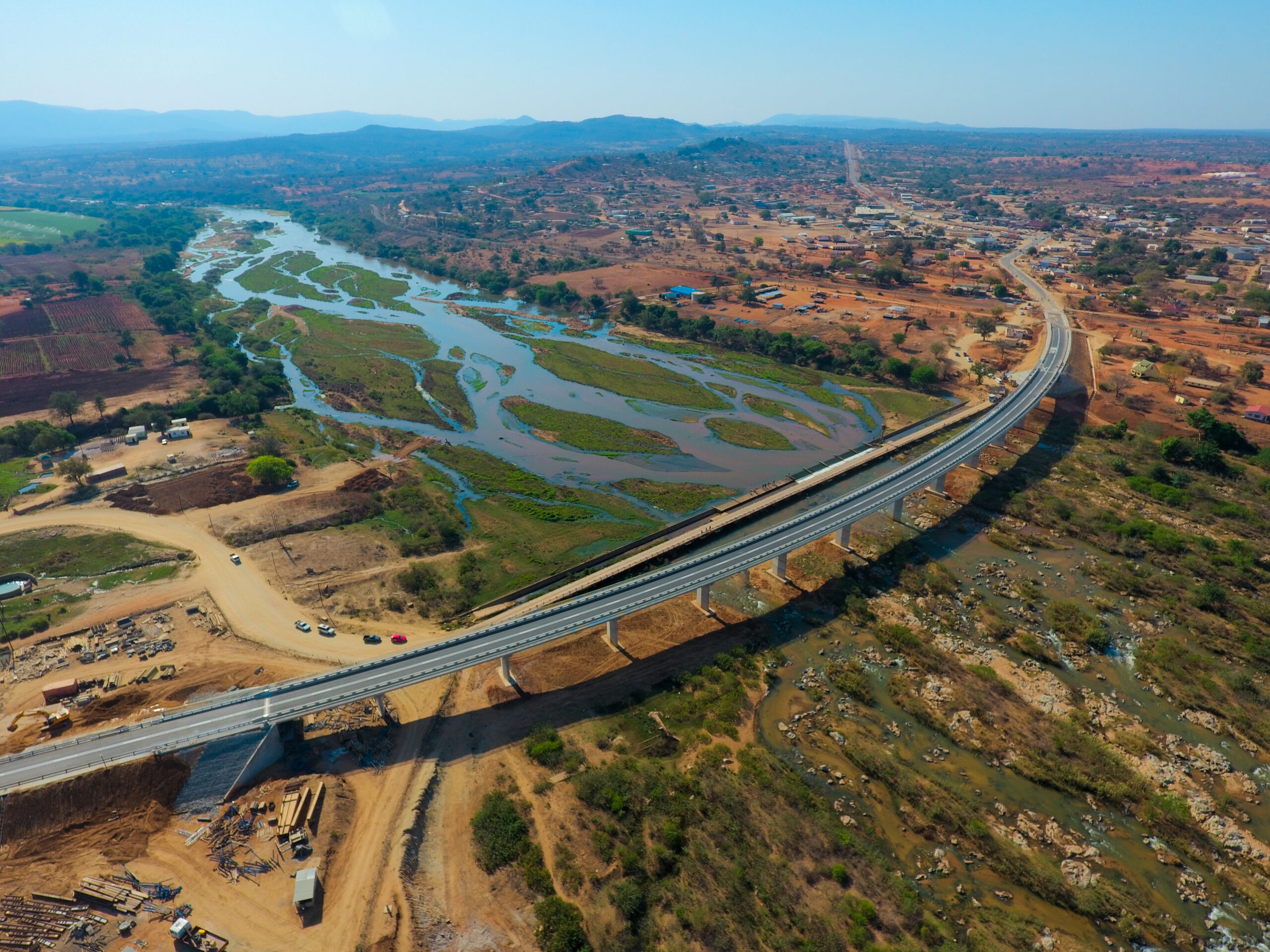
A bridge to a better life for communities in eSwatini.
Client
Government of eSwatini, supported by the European Union
Project date
2017
The 375-metre-long Siphofaneni Bridge over the Usutu River stands as a symbol of progress and connection in eSwatini. This impressive structure forms part of the 23 km St Phillips Road upgrade project, undertaken with the support of the European Union. Designed to reduce transportation costs for sugar farmers and improve access for local communities, the bridge has significantly enhanced mobility and economic opportunity in the region.
The opportunity
Before the construction of the Siphofaneni Bridge, communities relied on three existing river crossings downstream, two of which were single-lane low-water structures that became impassable during flooding. The nearest high-level bridge was approximately 30 km away, making daily travel difficult, particularly for school children and farmers transporting sugar cane. The new bridge provided a much-needed, safe, and permanent solution to this long-standing challenge.
What we did
Zutari was commissioned to conduct the preliminary and detailed design, assist with tender evaluation, and supervise construction. Due to the width and flow of the Usutu River, the largest in the country, traditional formwork construction was not feasible. An incremental launch method was selected instead.
Unlike typical incrementally launched bridges that use concrete post-tensioned with concentric cables to prevent cracking, the Siphofaneni Bridge was built using reinforced concrete. Zutari adopted a cost-effective approach by allowing controlled cracking during construction, eliminating the need for frequent visits from specialist subcontractors. Final-stage post-tensioning was applied once the deck was in place to close all cracks, achieving both durability and efficiency.
An incrementally launched bridge over the Usutu River, improving safety and connectivity for rural communities.
The outcome
Officially inaugurated in June 2017, the bridge has transformed daily life in the region. It now provides safe passage for school children, access to shops and clinics, and reliable transport routes for farmers, even during floods. The project also contributed to local economic development by improving trade and agricultural logistics.
The Siphofaneni Bridge demonstrates Zutari’s commitment to combining innovative engineering with meaningful social impact. Recognised for its excellence, the project won the Most Outstanding Project in Structural Engineering at the 2017 South African Institution of Civil Engineering (SAICE) Awards.
By rethinking conventional bridge design, Zutari delivered a cost-effective and resilient structure that connects communities and strengthens eSwatini’s rural economy.
Related
projects
Co-creating globally impactful projects that drive sustainable growth and reframe what’s possible.