



From moving people and goods to unlocking productivity, investment and economic opportunity
Transport infrastructure is often called the backbone of an economy: roads connect producers to markets, railways move bulk commodities, ports link domestic industry to global trade, and public transport connects people to work. Its economic role, however, goes beyond movement. It can act as a multiplier, shaping not only the activity generated by investment but also the productivity, competitiveness, investment appeal and spatial development of the economy it serves. Adam Smith made the essential point in 1776: better roads and waterways lower the cost of carriage and bring remote regions closer to market (Mngqibisa, 2005).
The key question is:
What additional economic activity becomes possible because the transport system is more accessible, reliable, efficient and connected?
The multiplier works through three interconnected channels that unfold over different time horizons. Construction creates an immediate, demand-side stimulus. The operation delivers longer-term, supply-side benefits as costs fall and reliability improves. Accessibility then changes where economic activity occurs and what land is worth. Infrastructure is therefore not an isolated asset but part of an economic network (Figure 1).
Multiplier channel | Direct effect | Secondary spillover |
Capital investment | Public or private spending injects demand into construction, engineering, manufacturing and supporting industries | Supply-chain, income and investment loops; up to a 2.0% pass-through in the investment loop in South African modelling (DBSA, 2023) |
Productivity | Lower travel times, transport costs, congestion and uncertainty raise the efficiency of firms and workers | Higher total factor productivity, scale economies, agglomeration and competitiveness (OECD/ECMT, 2007) |
Asset values | Improved accessibility makes locations more attractive | Appreciating land and property values; potential value capture (Yusuf, 2026) |
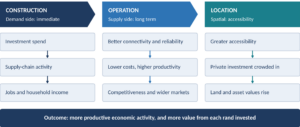
Figure 1: How transport investment can multiply through construction, operation and location effects.
Capital investment: the first multiplier
Infrastructure investment is key to stimulating economic growth, increasing employment, and reducing inequality. Increasing both private and public sector investment has been a strategy taken by several countries to stimulate economic growth. The most visible effect is the cost of delivering the asset. A new highway, railway, port expansion or public transport system creates demand for construction materials, plant and equipment, engineering services, project management, logistics, professional services and labour. The economic effect does not stop with the contractor.
A construction company purchases cement, steel, fuel and machinery. Its suppliers purchase inputs from their own suppliers. Employees receive income and spend part of that income on goods and services. Firms may subsequently invest in additional productive capacity when they anticipate sustained demand. Contractors buy cement, steel and fuel; suppliers buy from their own suppliers; workers spend their incomes, and firms may expand capacity once they expect sustained demand. This creates interconnected sectoral, income, investment and trade loops. The Cambridge E3ME modelling captures these sectoral, income, investment and trade loops. It is a structural macroeconomic model suited to analysing the impacts of Energy-Environment-Economy (E3) policies, allowing two-way linkages among the energy system, the environment, and the economy. Figure 2 illustrates how infrastructure spending ripples through an economy via interconnected feedback loops. It shows how initial demand flows through an Income Loop (driving employment, wages, and consumer spending), an Investment Loop (funding production inputs and future capacity), and a Trade Loop (linking local production to external markets).

Figure 2: A diagram illustrating E3ME’s economic structure
The Development Bank of Southern Africa’s modelling of infrastructure investment in South Africa illustrates the feedback loops in Figure 2. In 2023, DBSA estimated that the remaining R97 billion of the Infrastructure Fund would lift GDP about 0.3% above baseline by 2028 and employment by about 0.06%, with the strongest pass-through in the investment loop (2.0%), well ahead of intermediate demand (0.2%) (DBSA, 2023).
Three Key Limitations to Keep in Mind:
- Model Limitations: The DBSA reports modelled impacts rather than exact forecasts. Because it relies on a demand-side approach, it does not fully capture long-term gains on the supply side. Additionally, its scenarios were not transport-specific – a utilities-weighted scenario showed the largest overall impact, though the differences between scenarios were small.
- Economic Context: The actual multiplier effect depends heavily on local conditions, such as import leakage, domestic production capacity, location, and labour markets. For example, spending R1 billion on imported equipment creates far less local value than spending R1 billion to build local engineering and manufacturing capacity.
- Data Sources: Industry reports often cite higher multipliers, such as up to four times per rand invested in network infrastructure (Barnes, 2026). However, because this comes from sponsored content, it should be viewed as an optimistic upper limit rather than a guarantee.
Productivity: where the larger long-term opportunity lies
The most important multiplier effect of transport infrastructure may occur after construction is complete. Transport is an input into almost every productive activity.
A manufacturer needs to receive raw materials and deliver finished products. A mine needs to move commodities to processing facilities, rail terminals or ports. A retailer needs reliable distribution networks. A worker needs to travel to employment. A service provider needs access to clients and employees.
Improving the transport system, therefore, changes the productivity of other sectors. The OECD/ECMT (2007) distinguishes the direct effect of cheaper or better transport services from network externalities, in which removing a bottleneck widens markets, improves access to specialised inputs and generates scale and scope economies that feed into total factor productivity. Rodrigue and Notteboom (2024) add that transport is a small share of the cost of a typical good, yet no activity can occur without it, so modest changes in cost, speed, or reliability can have outsized effects.
Evidence closer to home points in the same direction. Analysing South African data from 1989 to 2018, a study by Mogoiwa (2023) showed that rail investments acted as a catalyst for economic growth, while economic growth itself did not drive rail spending. At the city level, Yusuf (2026) found that increasing public transport investment by one percentage point of city GDP raised GDP per capita by 0.045% across five emerging cities, including Johannesburg, even without an immediate boost to aggregate jobs. Looking beyond passenger transit to a freight corridor, such as a rail line connecting a mining region to a port, the primary visible benefit is lower vehicle operating costs and reduced travel times. However, the true economic value reaches further. Reliable corridor transport reduces required inventory buffers, boosts export capacity, and improves access to regional suppliers. In turn, these gains make exported commodities far more competitive, encourage new investment in local processing facilities, maximise the use of existing industrial assets, and unlock broader economic development along the route.
Accessibility: the economic value of connecting places
Transport changes accessibility, meaning how easily people and firms reach jobs, markets and services. Samuels argues that better connectivity cuts transaction costs, attracts foreign investment, supports new economic corridors and deepens SADC integration (NWU, 2024). In 2024, South Africa’s Deputy President similarly framed transport as foundational to regional integration under the African Continental Free Trade Area (AfCFTA), with strategic projects capable of attracting private investment (SAnews, 2024). A logistics park, for example, may become viable only once a new interchange or freight corridor is in place. Industrial land may become more attractive because it can access a larger market. A private developer may invest in warehousing because transport capacity and reliability have improved.
This is the point at which infrastructure begins to function as a platform for economic activity rather than simply as an asset because such benefits arise across a network, value is best assessed at the corridor level, not only at the project boundary.
Accessibility is also capitalised in land markets. Yusuf (2026) estimated a 0.12% rise in property values per percentage point of city GDP invested, almost three times the output effect, which supports value-capture tools such as betterment levies and development contributions. Appreciation is not purely beneficial: without integrated housing and land-use policy, it can displace lower-income households, and land adjacent to highways or airports can lose value due to noise and pollution (Rodrigue & Notteboom, 2024).
- There is no universal multiplier
Spending on transport infrastructure often promises yearly returns between 5% and 20%, but those returns decline as networks fill out. In well-connected areas, new projects may offer almost no added value. Assuming every new investment will perform like the first is a quick way to misallocate scarce capital (Rodrigue & Notteboom, 2024).
In reality, transport spending and economic growth feed into each other. Growth drives the need for better transport, just as better transport opens doors for growth. However, the timing of these benefits varies, and overbuilding leaves countries with costly, underused infrastructure. This is why thorough economic appraisals matter: they ensure every rand spent lands where it actually creates value. Figure 3 sets out the questions that decide how large the effect will be.
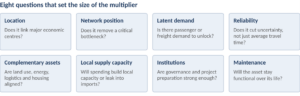
Figure 3: What determines the size of the multiplier for a given project.
The last of these matters in South Africa, where Mogoiwa (2023) notes that over 75% of the road network needs maintenance, and that Gautrain’s costs have been argued to exceed its measured benefits. Reliability deserves particular emphasis: repeated delays at ports, borders or corridors push firms to hold more inventory, run larger fleets and avoid markets, so improving reliability can be worth more than shaving average travel time.
The multiplier starts before construction: bankability
A project’s economic multiplier starts working long before construction begins. However, just because a project is economically valuable does not mean it is financially viable or “bankable” – that is, ready to secure funding. Today, the core debate in infrastructure has shifted from whether capital exists to whether projects are sufficiently well-prepared to attract it.
The scale of this gap is massive: a joint estimate by the World Bank and the DBSA, cited by Barnes (2026), puts South Africa’s transport and logistics modernisation needs at R13 trillion, far exceeding the R3 trillion, five-year target announced in May 2026. Closing that gap requires regulatory certainty, clear concession rules, and structured project preparation.
Indeed, early-stage preparation is an economic driver in its own right. In March 2024, the Deputy President revealed that a R200 million allocation from Infrastructure South Africa helped rescue 37 projects that would otherwise have sat dormant. Building transparent governance into these public–private partnerships helps lighten the government’s financial load while driving operational performance (NWU, 2024).
Moving Beyond the Multiplier
The real question isn’t simply “how big is the economic multiplier?” Instead, we should ask: What would happen if we built nothing? What benefits belong directly to this project? Who actually gains, when do those benefits arrive, and what risks could get in the way?
A multiplier measures broad, economy-wide growth, whereas a cost-benefit analysis asks a fundamental question: Is society better off with this project than with the alternatives? Both tools are useful, but they measure completely different things and shouldn’t be confused.
A credible evaluation brings everything together, combining cost-benefit analysis (travel time savings, lower operating costs, safety, and reliability) with traffic demand models, wider economic impact studies, and macro-modelling, while explicitly showing who wins and who loses.
Conclusion: the multiplier is ultimately about connectivity
Transport infrastructure is too often viewed merely as an expenditure item. A far more accurate perspective is to treat it as productive economic infrastructure. Its true value lies not in the concrete, steel, rails, or asphalt laid down, but in the economic potential unlocked by those assets.
The real multiplier is not a simple formula of “R1 invested yields R2 generated.” Instead, it is a continuous chain:
Investment → connectivity → accessibility → productivity → competitiveness → investment → economic opportunity.
This is the lens through which transport projects must be planned and evaluated. The essential question is no longer just whether a project moves vehicles efficiently, but which economic system this infrastructure enables—and how much long-term value will that system create?
The objective is not to maximise spending, but to maximise the economic return of every rand invested. When transport spending is strategically located, matched to genuine demand, integrated with land use, and backed by bankable project preparation and ongoing maintenance, its impact extends far beyond the transport sector. Transport infrastructure does not merely move the economy-it moves it forward.
References
Barnes, S. (2026) South Africa’s infrastructure future depends on fixing bankability, not capital allocation. BusinessTech (Standard Bank partner content), 29 September.
DBSA (2023) The Impact of Infrastructure Investment in South Africa. Msimango, Orffer & van Reenen. DBSA Infrastructure Research Colloquium, March 2023.
Mngqibisa, S. (2005.) The Role of Transport in Economic Development. KwaZulu-Natal Department of Transport.
Mogoiwa, M.R. (2023) An evaluation of the impact of transport infrastructure investment on the economic performance of South Africa. MM research report, Wits School of Governance.
NWU (2024) Investing in transport infrastructure for long-term economic recovery (Dr A. Samuels). News@NWU, 16 October.
OECD/ECMT (2007) Transport Infrastructure Investment and Economic Productivity. Round Table 132. Paris: OECD Publishing.
Rodrigue, J-P. & Notteboom, T. (2024) Transportation and economic development, in The Geography of Transport Systems, 6th ed. Routledge. transportgeography.org.
SAnews (2024) Transport infrastructure foundation for economic development in Africa, says Mashatile. 19 March.
Yusuf, J.A. (2026) The economic multiplier: public transportation investment and urban development in emerging cities. Frontiers in Energy Efficiency, 4:1714011.

